
The Mitchell Park Domes are unlike anywhere else on Earth—three soaring glasshouses where you can travel from a tropical jungle to a desert and through an ever-changing floral show, all in the course of an afternoon. Here are a few of our favorite things to know before you visit.
A ONE-OF-A-KIND BUILDING
- The only one of its kind in the world. The Domes are the world’s only beehive-shaped glasshouses—or, in architectural terms, conoidal rather than the standard geodesic dome. The shape isn’t just striking: it captures sunlight at a better angle for the plants and gives our tallest trees room to grow seven stories high.
- Designed by a Milwaukee original. Architect Donald L. Grieb won an international competition for the design, beating out 32 other architects from around the world. Its patented beehive-shaped concept has never been replicated anywhere else.
- Built one dome at a time. Construction was staggered over several years so the project could be paid for in yearly installments: the Show Dome was completed in December 1964, the Tropical Dome in February 1966, and the Desert Dome in October 1967. First Lady Mrs. Lyndon B. (Lady Bird) Johnson dedicated the Domes in 1965.
- A nationally recognized landmark. In 2017, the National Trust for Historic Preservation named the Domes a National Treasure. In 2026, the Mitchell Park Horticultural Conservatory was added to the Wisconsin State Register of Historic Places, and a nomination to the National Register of Historic Places is now under review by the National Park Service.
A LIVING COLLECTION
- The whole world, under glass. The Domes are home to about 2,000 plants from climates across the globe—a living museum that takes you to another continent, another time, even another world.
- The show always changes. In addition to its permanent collection, the Show Dome boasts a non-permanent collection that transitions multiple times a year—so there’s always a reason to come back.
- Our tallest resident. A Canary Island Date Palm in the Tropical Dome reaches toward the glass reaching nearly 70 feet tall—and it’s an original planting, here since the dome first opened.
- A rare desert treasure. The Desert Dome is home to our rarest holdings, including a remarkable Madagascar collection donated more than 40 years ago by the Ambassador of Madagascar.
- It’s not just plants. Nearly 100 birds and fish make their home in the Tropical and Desert domes, and beneficial insects live and work in all three.
- Greener behind the glass. Seven greenhouses sit behind the Domes—six for growing and propagating—plus a larger greenhouse used as an event space. The green roof on the Education Center adds energy efficiency, helping keep the building warm in winter and cool in summer.
THE DOMES BY THE NUMBERS
- A destination for the whole region. Nearly 300,000 people visit the Domes each year—a beloved local landmark that also draws more than 100,000 visitors annually from outside Milwaukee County. The average non Milwaukee County resident travels more than 200 miles to visit the Domes.
- Where learning grows. About 6,000 area youth take a field trip to the Domes every year, and our education team runs year-round programming for students, families, and adults alike.
- The hands that tend it all. A team of seven full-time horticulturists cares for the indoor and outdoor gardens and the green roof, every day of the year.
- Shopping with a purpose. The “Gifts Under Glass” gift shop is operated by Milwaukee Domes Alliance, with proceeds supporting the mission of the Domes: Providing inspirational experiences that restore connections to nature and community in a one-of-a-kind horticultural oasis at the heart of Milwaukee.
TECHNICAL SPECS
| Size | A full acre under glass. Each dome is 140 feet across and 85 feet high (about seven stories), enclosing roughly 15,000 square feet. |
| Shape | The world’s only beehive-shaped (conoidal, not standard geodesic) glasshouse. The cone shape allows a better angle for solar heating and more height for tall trees. |
| Structure | A concrete frame with aluminum guttering and a glass skin. |
| Glass | Each dome is covered in 2,000 triangular panes of ¼-inch, wire-embedded glass—6,000 panes across all three domes. |
| Heating | Four one-million-BTU low-pressure boilers fueled by natural gas, with a fuel-oil backup system. |
| Cooling | A fan system around the base and top of each dome keeps things comfortable; a complete air exchange takes about 3½ minutes. |
| Getting to the top | A maintenance elevator is suspended inside the top of each dome and can be lowered to within a few feet of the floor. |
| Pest control | Beneficial insects are strategically introduced to manage pests naturally across all three domes and the greenhouses. |
| Watering | Plants are watered by hand every day. City water is pumped into a tank and heated before use, and the Tropical Dome uses an extensive misting system. A water-reclamation process captures rainwater for use throughout the growing greenhouses. |
It’s all part of how the Domes inspire meaningful connections to nature and community—right in the heart of Milwaukee.
AT THE DOMES

Domes Reimagined Plan: The Future of the Domes
Learn More
Fall Show 2026: Treasure of the MUMmies September 19th – November 8th
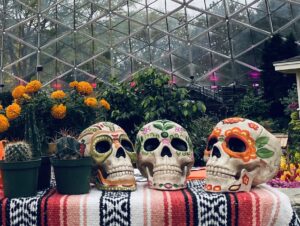
Día de los Muertos (Day of the Dead), October 30th, 6 PM – 9 PM