The Milwaukee Business Journal Profiles MDA CEO Christa Beall Diefenbach
The Milwaukee Business Journal has profiled our CEO, Christa Beall Diefenbach, in its Executive Profile series, alongside its coverage of the Domes Reimagined plan. For readers without access to the article, here is the full story.
A National Treasure. In 2017, the National Trust for Historic Preservation named the Domes a National Treasure. In 2026, the Mitchell Park Horticultural Conservatory was added to the Wisconsin State Register of Historic Places, and a nomination to the National Register is now under review by the National Park Service. The National Trust designation and State Register listing independently affirm that this place is worth carrying forward, while the National Register nomination advances through federal review.
And Milwaukee Can Carry It Forward.
Independent review has affirmed that the building is structurally sound.
That sound structure gives Milwaukee a strong foundation for what comes next. Domes Reimagined renews the glass and the systems underneath, opens the site to visitors of every ability, lowers the investment from tax payers, and reconsiders the whole of Mitchell Park around it. The domes your grandchildren walk through will be the same in many ways — only better!
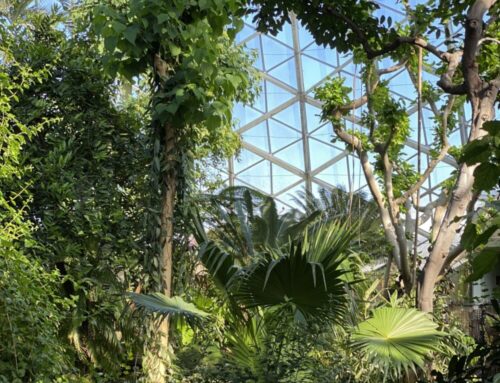
There Is Nothing Else Like It. Architect Donald L. Grieb won an international competition for the design, beating 32 other architects from around the world. The patented beehive shape — conoidal, not the standard geodesic — has never been built anywhere else since. A full acre under glass, each dome stands seven stories high with more than 6,000 triangular panes of glass across the three.
This National Treasure Remains a Living Part of Milwaukee. Nearly 300,000 people visit each year. More than 100,000 of them come from outside Milwaukee County, traveling an average of more than 200 miles to get here. About 6,000 area youth participate in an annual field trip, traveling through about 2,000 plants from climates across the globe — six desert climates and a lush jungle, all in the course of an afternoon. Imagine this being possible even in the middle of a Wisconsin winter!
The Next Chapter Is Being Written by a Broad Coalition. Public partners, architects, historians, preservation experts, elected leaders, community organizations, board members, donors, volunteers, and supporters across Milwaukee are carrying this work together. Sustaining that shared commitment is much of what the profile is actually about.
Lady Bird Johnson dedicated this place in 1965. More than 60 years on, Milwaukee is carrying it forward and shaping what will be.
This is the thoughtful renewal of a National Treasure — and the next chapter of a Milwaukee story.
A Plan of This Scale Depends on Who Is Carrying It.
The Business Journal’s Executive Profile series looks at the people leading Milwaukee’s institutions. This week it turned to MDA CEO Christa Beall Diefenbach, who has led this organization since 2021 — through the period when the Domes’ future was genuinely uncertain, and led the transition to a visionary plan for the future.
Hanna Paul, chief customer officer at Ideawake and a Domes volunteer who has known her since early in her tenure, described what she brings to the role as “dedication, consistency, reliability and a steady energy.”
Continuity of leadership is not a small thing in a project measured in decades. The rest of that story — how she came to this work, and what she sees in the Desert Dome — is hers and the Business Journal’s to tell.
About Milwaukee Domes Alliance:
As the operating partner of the Mitchell Park Horticultural Conservatory, the Milwaukee Domes Alliance helps cultivate a lifelong love of nature for all visitors through coordinating immersive, restorative experiences within the iconic horticultural oasis. Our mission is to inspire meaningful connections to nature and community. We provide educational and membership programming, retail services, funds for facility enhancements, and volunteer recruitment and management in support of the Mitchell Park Horticultural Conservatory, and have done so since the 1980s. Revenues to support this mission come from fundraising, membership dues, and retail sales.